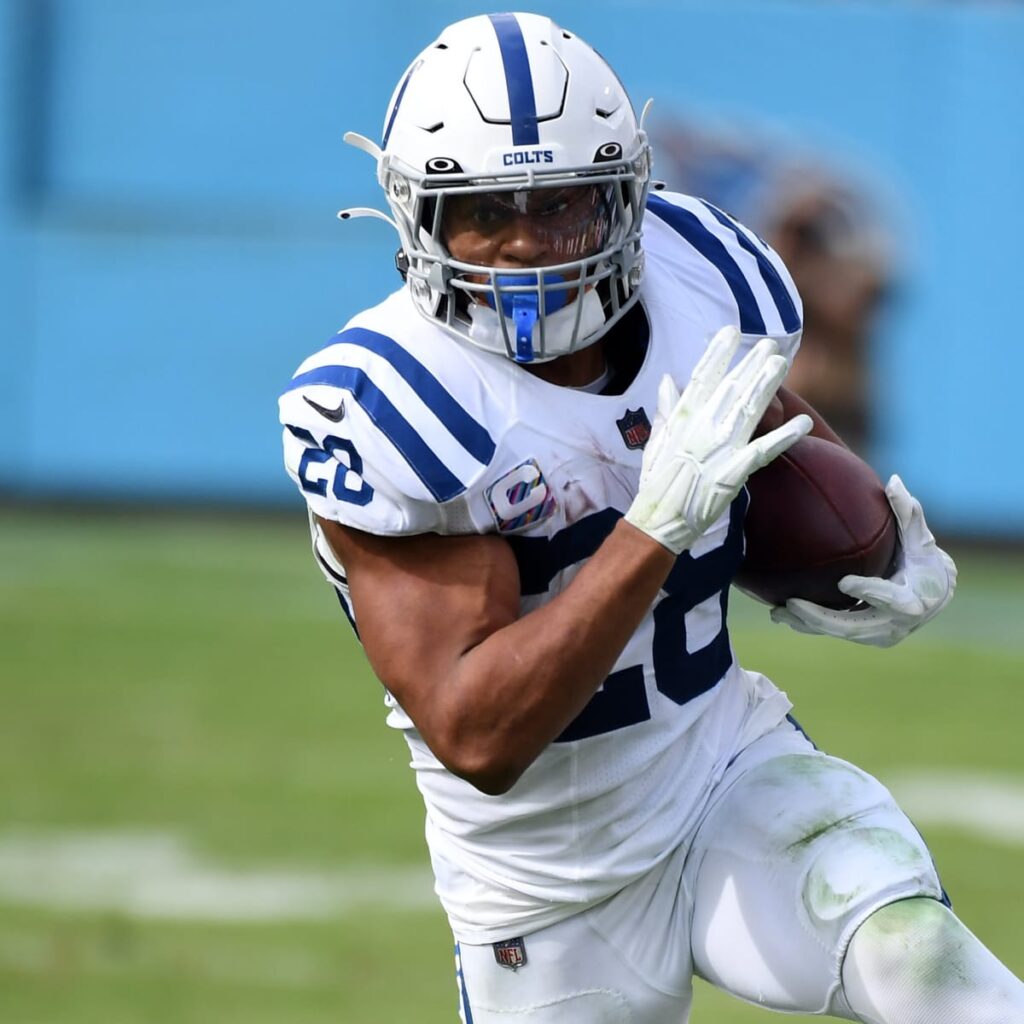
2023 Indianapolis Colts Outlook
The 2023 NFL season is right around the corner and that means fantasy football drafts are underway. Before you assemble your championship dynasty, redraft, or high-stakes squad, FullTime Fantasy members will have an in-depth, player-by-player preview of all 32 teams from football legend Shawn Childs.
Also, check out Jody Smith’s NFL offensive line rankings and exclusive 2023 Strength of Schedule analysis.
Up next in our extensive NFL and fantasy football preview series is Shawn’s deep dive into the 2023 Indianapolis Colts Outlook.
— PROJECTIONS —

— Coaching Staff —
After a disastrous 4-12-1 season, the Indianapolis Colts named Shane Steichen as their head coach. Most of his coaching career came in the Chargers’ system. Steichen worked his way up to their offensive coordinator in 2019. He had success running Philadelphia’s offense over the past two seasons, leading to his promotion in 2023. Overall, Steichen has 13 years of experience coaching in the NFL.
Jim Bob Cooter takes over as the Colts’ offensive coordinator. That is a position he held from 2016 to 2019 with the Detroit Lions. He worked on Shane Steichen’s staff last season as the Eagles’ passing game coordinator. His NFL coaching career started in 2009 with Indianapolis (offensive assistant).
The Colts fell to 30th in points scored (289), a mere 162 fewer than in 2021 (451). They also finished at the back of the league in offensive yards (27th).
Gus Bradley returns for a second season to run Indianapolis’s defense. He held the same position with the Chargers and Raiders over the previous four seasons. He went 14-48 over four years as the head coach of the Jacksonville Jaguars. Bradley has been in the NFL since 2006, with most of his experience as a defensive coordinator.
The Colts ranked 15th in yards allowed, but they allowed 427 points (28th). In 2021, their defense held offenses to 62 fewer points.
— Free Agency —
Indianapolis lost LB Bobby Okereke (NYG), DE Yannick Ngakoue (FA), and S Rodney McLeod off their defense. The Colts added DE Samson Ebukam and DT Taven Bryan to their defensive rotation.
QB Gardner Minshew played under Shane Steichen at Philadelphia over the past two seasons, giving the Colts veteran experience to help bridge the gap to Anthony Richardson. The only other offensive change of value was WR Parris Campbell signing with the Giants. Indianapolis replaced him with WR Isaiah McKenzie.
— Draft —
The Colts came out of the 2023 NFL Draft with 12 new players, highlighted by selecting QB Anthony Richardson with the fourth overall pick. He profiles as a big strong running quarterback with exceptional speed (4.43 40-yard dash at the NFL combine) for his size (6’4” and 245 lbs.). However, his accuracy (54.7% completion rate) was an issue in his limited experience in college. Richardson must improve his throwing mechanics and prove he can read NFL defenses. He does have a feel for oncoming pass rushers while standing tall in the heat of the battle when looking for a breaking-free receiver.
Four of their following six selections went to the defensive side of the ball – CB Julius Brents (2nd), DT Adetomiwa Adebawore, CB Darius Rush, and S Daniel Scott.
Brents is a physical cornerback with an edge in height (6’3”). He projects well in press coverage while adding value to the run defense and understanding developing pass routes. His eyes will spy on the quarterback, inviting some blown coverages. Brents has an aggressive style but can’t overcome lost steps vs. speedy/quick wideouts.
Adebawore doesn’t have the overall build (6’2” and 280 lbs.) to anchor the interior line. But he makes up for this shortfall with strength and exceptional speed for his position. His early movements create wins that don’t always put him in the correct place to make plays. Overall, Adebawore lacks the pass rush and tackling ability to earn starting snaps on the outside of a defensive line. With a little more bulk, his game should kick up a notch at defensive tackle.
Size was the plan for the Colts when looking for upgrades at cornerback in this year’s draft. Rush comes in at 6’2” and 198 lbs. with blazing speed (4.36 40-yard dash). He transitioned from wide receiver to defensive back in college, requiring him to learn on the fly. Out of the press, Rush fits the bill in the drop and trail position, where covering longer routes should be his edge. His transition quickness isn’t there to win over the short areas of the field vs. shifty route runners with depth of moves.
Scott checks the athletic, speed, and strength boxes for a deep safety. His vision and attack in run support grades well while needing to improve when falling into coverage one-on-one with top wideouts. Scott must avoid getting trapped too close to the line of scrimmage, where a blocker can remove him from his responsibility.
In the third round, Indianapolis added WR Josh Downs. Many teams in this year’s draft are looking for the next Tyreek Hill. Downs doesn’t have top-end speed (4.48 40-yard dash). Plus, he needs to add some bulk (5’9” and 170 lbs.) to handle the riggers of a high-volume receiver at the next level. His flow after the snap has an electric feel, creating easy wins over the short areas of the field while also having the wheels to beat a defense deep. Downs brings tempo and solid route running to the Colts. But he must improve his rhythm and timing vs. better defenders.
Indianapolis invested in a pair of offensive linemen in the fourth (T Blake Freeland) and seventh (Jake Witt) rounds.
Freeland has the wingspan to handle attacking pass rushers outside his frame. He also has the vision and movements to win in pass protection. His struggle early in his career comes in run blocking due to lacking the bulk to match his size (6’8” and 300 lbs.). However, bully players may give him fits early in his career.
Witt has almost the identical build (6’7” and 300 lbs.) as Blake Freeland. But Witt falls into the developmental project mode. His base needs work while adding more weight to his frame is necessary to increase his wins in run blocking. Witt was a former tight end, giving him speed and rhythm to his movements in pass protection.
The Colts shifted to their offense with two players in the fifth round – TE Will Mallory and RB Evan Hull.
Mallory has the foundation to improve as a pass catcher due to his speed (4.54 40-yard dash) and route running. Unfortunately, he doesn’t have the build (6.4” and 240 lbs.) to earn many snaps when asked to block. His play strength has a reasonable foundation. But Mallory must showcase more nastiness to his game to win in tight coverage and beat defenders off the line of scrimmage. At the very least, he gives Indianapolis a tight end to stretch the field, with value running crossing routes.
Hull is a power runner who lacks the wiggle to take advantage of tight cut-back lanes. He has above-average experience as a pass catcher while not quite there yet in his pass protection. If given a window, Hull has the speed to finish a run over the long field.
The final two additions in this year’s draft class went to the Colts’ defense – LB Titus Leo and CB Jaylon Jones.
Leo played at a small college (Wagner), requiring him to prove his worth vs. more talented opponents. He gets off the ball well with a feel to separate from blockers. Leo wants to attack the line of scrimmage in run support while also being willing to switch to the quarterback on play-action calls. The next step in his development is improving his anchor when forced to the outside.
Jones is another cornerback with size (6’2” and 200 lbs.), but he does lack the technique needed to defend elite wide receivers when asked to match their route running. His quickness and physical presence play well in press coverage. Jones falls short in coverage over the long field, and wideouts will create easy wins vs. him over the short areas when playing off the ball.
— Offensive Line —
Indianapolis plunged to 23rd in the NFL in rushing yards (1,866 – 674 yards fewer than 2021) with eight touchdowns. They also had a mere nine runs over 20 yards. Their ball carriers gained 4.2 yards per rush. The loss of Jonathan Taylor for eight games was a big part of their demise running the ball.
Indy bumped to 20th in passing yards (3,854) with 17 touchdowns and 20 interceptions while gaining only 6.4 yards per pass attempt. Their offensive line allowed a glaring 60 sacks (28 more than in 2021).
LT Bernhard Raimann was on the field for 13 games in his rookie season after getting drafted in the third round in the 2022 NFL Draft. He held his own in run blocking, but he did allow too much pressure on the quarterback in six matchups. He’ll compete with incoming rookie Blake Freeland for the starting job.
The Colts have three top players (Quenton Nelson, Ryan Kelly, and Braden Smith), but they all played below their previous levels. Nelson has the highest ceiling in all areas, while Smith has been an elite blocker in multiple seasons. The right guard position will be an open battle.
Indianapolis has the talent on their offensive line to beat the league average, but they also need a quarterback who gets the ball out quickly. The run game should perform well, with more upside with Anthony Richardson behind center.
See where Indy’s revamped O-line grades out in Jody Smith’s NFL Offensive Line Rankings.
— Offense —
Game flow led to Indianapolis throwing 80 more pass attempts than the previous season (524). In 2021, the Colts ran a balanced offense, thanks to the elite season by Jonathan Taylor. Their new coaching staff wants to run that ball based on their game plan in Philly. Ultimately, the number of starts by Anthony Richardson sets the tone for their game plan.
— Quarterback —
Anthony Richardson
After limited playing time in 2021 (930 combined yards with nine touchdowns and five interceptions), Richardson made 12 starts for the Florida Gators last year. He ran the ball exceptionally well (103/654/9) while finishing with weakness in his completion rate (53.8) and low pass attempts per game (27.3). His passing stats (2,549 yards with 17 touchdowns and nine interceptions) didn’t showcase a star passer.
Richardson has an electric flow when running the ball that puts him closer to Lamar Jackson than Jalen Hurts. When in the open field, he has the feel to set up defenders and the acceleration to pick up big chunks of yards. Richardson throws with touch and accuracy downfield when his breaking receiver has a wide window of daylight. His challenge comes when throwing timing routes over the short areas of the field.
Fantasy Outlook: The Colts’ quarterbacks only ran the ball 46 times for 165 yards and one touchdown last season. Richardson should beat those totals in about three games. In the early draft season, he is the 17th-ranked quarterback despite no clear information about the number of games he will start. However, the bet and his floor come from his running ability. But Richardson can’t be a difference-maker without throwing the ball better. The new Colts’ head coach invested in Richardson, meaning he’ll quickly move into the starting lineup. I expect 12 to 13 starts, with his best play coming late in the season.
Gardner Minshew
Over his first two seasons, Minshew went 7-13 as the starting quarterback for Jacksonville. His touchdown to interception ratio (37:11) graded well while averaging 240 passing yards per game. A thumb issue led to him losing his starting job over the second half of 2020.
Minshew appeared in nine games over the past two seasons for the Eagles. He completed 62.5% of his passes for 1,102 with seven touchdowns and four interceptions while chipping in with 16 rushes for 24 yards and one score. In his two starts in 2022, Minshew threw for 629 yards with three touchdowns and three interceptions.
Fantasy Outlook: His experience in Philadelphia suggests that Indy may use Minshew as their starting quarterback in September. I don’t expect him to be drafted in 2023, but he may surprise in short spurts.
Other Options: Sam Ehlinger
— Running Backs —

The Colts’ running backs lost 0.89 yards per rush and 2.18 yards per catch from their 2021 stats. They scored 15 fewer touchdowns while gaining 2,301 combined yards with 99 catches. Over the past three seasons, their backs averaged 519 touches, with elite scoring in fantasy points (32.02) in PPR leagues in 2020 and 2021. A certain rookie running quarterback could steal rushing attempts and touchdowns.
Jonathan Taylor
The Colts gave Taylor about 50% of their running back snaps over the first five weeks in 2021, leading to less value than expected running the ball (73/327/2). However, he did shine twice (6/60 and 3/116/1) over this span catching the ball. Indy gave him more than 80% of their snaps over their final eight games. Taylor had a floor of 95 combined yards over his last 12 games while turning into a beast running the ball (259/1,484/16). His role in the passing game dwindled over his final five contests (4/24). He finished the year first in running back scoring (375.10) in PPR leagues with 2,171 combined yards, 20 touchdowns, and 40 catches.
Last season, Taylor kicked in the door in Week 1 (175 combined yards with one touchdown and four catches on 35 touches). He picked up a toe issue in late September, followed by an ankle injury that later required surgery. Taylor missed six games while posting an empty showing (one catch for 13 yards) in Week 15. His only other game of value came in Week 10 (22/147/1 with two catches for 16 yards). In his 10 full starts, Indy gave him 21.9 touches per game.
Fantasy outlook: Taylor is big and fast with an electric ceiling in scoring, but he needs better quarterback plays to extend drives and create more scoring chances. After a down season, Taylor is the fourth running back drafted with an ADP of 12 in PPR formats in the high-stakes market. Indianapolis should give him all the carries he can handle. Expect a floor of 1,500 combined yards with a dozen scores and a run at 50 catches. I expect his stock to rise as the draft season moves closer to September.
Evan Hull
Over his final two seasons at Northwestern, Hull delivered two productive years (196/1,009/7 with 33 catches for 264 yards and two touchdowns and 221/913/5 with 55 catches for 546 yards and two scores). He gained over 200 yards twice (24/220/4 and 22/216/2) in college, with eight showing with more than 100 rushing yards.
Fantasy Outlook: Based on the structure of the backup Colts’ running backs, Hull has the best resume to catch the ball. His grinder style puts him in a coin clip battle to be the top handcuff to Jonathan Taylor in 2023.
Zack Moss
In 2021, Moss appeared to be the favorite for goal-line and short-yardage carries for the Bills. He missed Week 1 with a slow recovery from ankle surgery. Over the next four games, Moss gained 278 combined yards with four touchdowns and eight catches on 54 touches. A concussion issue knocked him out of three games in November. Moss offered no fantasy value over his final nine games (264 combined yards with one score and 15 catches on 65 touches).
Last year, Moss had a minimal opportunity over his first nine games (24/122/1 with seven catches for 27 yards) between Buffalo and Indianapolis. He missed three games midseason before his trade. The Colts gave Moss their lead running back role over the final four games (69/334/1 with four catches for 12 yards on 73 touches) with Jonathan Taylor injured.
Fantasy Outlook: Moss has four years of experience, but his best opportunities came over his first two years in the league. His pass-catching ceiling is low, suggesting he is only an early down handcuff option this season.
Deon Jackson
The early season injury to Jonathan Taylor gave Jackson starting touches, leading to 218 combined yards with one touchdown and 14 catches. Most of his success came in Week 6 (12/42/1 with 10 catches for 79 yards). He played his way out of the running back rotation over the next 10 games (41/135 with 16 catches for 101 yards and one score).
Over four seasons with Duke, Jackson gained 2,801 combined yards with 22 touchdowns and 61 catches on 587 touches.
Fantasy Outlook: His best chance to get on the field this season will be on passing downs if the Colts have a few injuries at running back.
Other Options: Jake Funk, Darius Hagans
— Wide Receivers —

Indianapolis posted three-year highs in catches (224), receiving yards (2,451), and targets (10) for the wide receivers. On the downside, they gained only 10.9 yards per catch. They also declined in touchdowns (10). The receiving opportunity for the Colts’ wideout could be much lower this year if they attempt fewer than 30 passes per game with Anthony Richardson behind center.
Michael Pittman
Pittman more than doubled his rookie production (40/503/1 on 61 targets) in 2021 (88/1,082/6). His best stats came first 10 games (55/729/5 on 76 targets), highlighted by four weeks (8/123, 6/89/1, 4/105/1, and 10/86/2). However, once the Colts shifted to their run game and Jonathan Taylor, Pittman had a sharp decline in his output over his final seven starts (33/389/1 on 53 targets). His catch rate (68.2) commands more chances.
Last season, he finished with a new top in catches (99) and targets (141), but Pittman only gained 9.3 yards per catch. His best two outputs (9/121/1 and 13/134) came over the first six weeks. He had a minimum of seven catches in seven starts. Pittman finished 20th in wide receiver scoring (217.50) in PPR formats, compared to 18th in 2021 (238.60 fantasy points).
Fantasy Outlook: Pittman has a volume WR1 skill set while trending upward. Even with his growth over the past two seasons, he remains a backend WR2 in fantasy leagues. In the draft season in the high-stakes market, Pittman is the 23rd wide receiver selected, fitting in the range I would expect based on fewer balls flying in the Colts’ offense this season. I’ll lower his outlook to about 80 catches for 90 yards and about five scores.
Check out FullTime Fantasy’s Strength of Schedule tool to see how Indy’s 2023 playoff slate looks.
Alec Pierce
Over 32 games in college over three seasons, Pierce caught 106 of his 173 targets (61.3%) for 1,851 yards and 13 touchdowns. His best season came in 2021 (52/884/8). He came to the NFL with an edge in size (6’3” and 210 lbs.) and speed (4.41 in the 40-yard dash at the 2022 NFL combine).
However, Pierce does have some limitations in his short-area quickness and release. He plays with a tight-end mentality that projects well in run blocking and winning in tight coverage. Pierce won’t gain an edge with his route running over the first 10 yards past the line of scrimmage, but his build-up speed will create separation downfield. Pierce should shine in the red zone while scoring on many fade-type passes.
In his rookie year, Pierce caught 41 of his 78 targets for 593 yards and two touchdowns. After a zero in Week 1 and a missed game, his stock rose over the following four matchups (3/61, 4/80, 8/81, and 3/49/1). He finished the season with WR3 snaps for the Colts while offering only one other game of value (4/86/1) over his final 11 contests (23/322/1).
Fantasy Outlook: Pierce handled himself well in his first year in the pros, giving Indianapolis a second developing wideout to help their passing game. His next step should be about 50 catches for 700 yards with minimal impact in scoring. Pierce projects to be a borderline WR6 in 12-team fantasy leagues.
Josh Downs
The North Carolina Tarheels gave Josh Downs an elite opportunity over the past two seasons, leading to 194 catches for 2,373 yards and 19 touchdowns on 268 targets over 24 games. He sat out two games last year with a lower-body injury while choosing to opt out of his team’s bowl game. Downs had a sensational four weeks (9/126, 11/102/2, 15/166/1, and 11/154/3) in 2022. Over the past two seasons, he had eight catches or more in three-quarters of his starts.
Fantasy Outlook: Downs should be a fun follow this year, and he should have an active role out of the spot for the Colts. His ability to win over the short areas of the field will help move the chains and offer sneaky value at the goal line. I’ll set his bar at 60 catches for 700 yards with four to six touchdowns. I expect his opportunity to rise as the season moves on.
Isaiah McKenzie
Over the past four seasons, McKenzie worked as the Bills’ fourth wide receiver. He set career highs in catches (42), receiving yards (423), and targets (65) last season but only helped fantasy teams in two games (78/76/1 and 6/96/1). Buffalo had him on the field for 46.8% of their snaps in 2022.
Fantasy Outlook: When at his best, McKenzie slips through the cracks in coverage by defenses. He has success on easy crossing routes, with most of his catches coming over the short areas of the field (9.5 yards per catch in his career). He’ll compete for Josh Downs for playing time while offering a much lower ceiling. McKenzie won’t be drafted in 12-team formats.
Mike Strachan
Strachan had 78 catches for 1,319 yards and 19 touchdowns in his junior season at Charleston. His college team didn’t play in 2020, leading to no momentum in the 2021 NFL Draft (seventh-round selection). He is a high-point catcher who will need time to develop.
Strachan offers elite size (6’5” and 225 lbs.) to the wide receiver position. He creates wins on jump balls and fades at the goal line, but his speed and route running won’t separate him from his peers.
Strachan caught only five passes for 85 yards in his two seasons with Indianapolis.
Other Options: Ashton Dulin, Vyncint Smith, Malik Turner
— Tight Ends —

The previous Colts’ coaching staff gave their tight ends reasonable chances to make plays over the past three seasons despite lacking a clear-cut TE1. Over this span, their tight ends secured about 20% of the team’s passing yards, which aligns with the NFL average. They gained under 11.00 yards per catch for each of the previous three years, with 22 touchdowns over 50 games.
Jelani Woods
After a quiet first three seasons at Oklahoma State (31/361/4) over 22 games, Woods played much better in 2021 (44/598/8) upon transferring to Virginia. His overall blocking isn’t where it needs to be, but he has yet to fill into his body. In the passing game, Woods offers questionable hands and route running.
In his first season with the Colts, Woods caught 25 of his 40 targets for 312 yards and three touchdowns, highlighted by two surprising games (2/13/2 and 8/98). Indianapolis had him on the field for 60% or more their snap in three of his final six matchups.
Fantasy Outlook: The tight end rotation for Indy will fluctuate from week to week, depending on game flow and game score. Woods may be better than his resume showed in college, but he is only a fantasy gamble until the Colts give him starting snaps.
Kylen Granson
Over his last two seasons at SMU, Granson caught 78 passes for 1,257 yards and 14 touchdowns on 120 targets. He has a big wide receiver feel, which may lead to him leading Indy in tight-end production early in his career.
His speed over the long field will be his best asset to start his NFL career. Granson needs to work on his running route while failing short as a blocker. Defenders in tight quarters will challenge his hands. He’ll test safeties at the third level of the defense with the wheels to score if Granson finds a seam.
Granson finished his rookie season with 11 catches for 106 yards on 15 targets with no games of value. He missed the final three games of 2022 due to an ankle injury. Over 13 games of action last season, Granson caught 31 passes for 303 yards and no scores on 40 targets. He had more than four targets in only one game (7 in Week 1 – 3/22) while catching four passes in four contests (4/62, 4/38, 4/57, and 4/19).
Fantasy Outlook: Granson may lead the Colts in tight end snaps this year (second in 2022), but he has yet to show the big play or scoring ability on his college resume.
Will Mallory
Over five seasons at the University of Miami, Mallory made baby strides in his play and production each year. He finished with 115 catches for 1,544 yards and 14 touchdowns, with his top output coming in 2022 (42/538/3).
Fantasy Outlook: Mallory will start this season third, possibly fourth on the Colts’ tight end depth chart. He may surprise in a game or two But his overall skill set isn’t ready to handle a starting tight end job in the NFL.
Other Options: Mo Alie-Cox, Pharaoh Brown, Andrew Ogletree
— Kicker —
Matt Gay
For fantasy drafters waiting on a kicker in 2021, Gay rewarded them with an excellent season. He made 94.1% of his field goal chances with success from 50 yards or more (4-for-5). His leg held value last season (28-for-30), with his only two misses coming from long range (7-for-9 from 50 yards or more). Over 41 games with the Rams, Gay failed on two of his 97 extra-point.
In 2022, Indianapolis scored only 28 touchdowns while creating 39 field goal chances.
Fantasy Outlook: Despite success over the past two seasons, Gay ranks as the 23rd kicker in late May. The Colts’ offense should stall in the red zone until their young quarterback proves he can pass for touchdowns in close. I’m a fan of Gay, and he should prove to be more than a matchup-kicking option in 2023.
— DEFENSE —
Indy fell to 20th in rushing yards allowed (2,109) due to an increase in rushing attempts against (30.0 per game). They gave up 4.1 yards per carry (4.4 in 2021), with ballcarriers scoring 20 touchdowns.
The Colts climbed to 12th in pass yards allowed (3,980). Their defense finished with 44 sacks while giving up 25 passing touchdowns with 10 interceptions.
LB Shaquille Leonard remains Indy’s top defender against the run with a history of a high volume of tackles and help in coverage. Unfortunately, he missed 14 games in 2022 due to multiple injuries (back, concussion, and nose). LB Zaire Franklin picked up the slack last season by delivering 167 tackles, three sacks, and three forced fumbles. The Colts’ third linebacking job is up for grabs, with no one standing out.
DT DeForest Buckner remains a steady force in the center of Indianapolis’s defensive line. He handles himself well vs. the run while securing 142 tackles and 15 sacks over the past two years. The Colts hope DT Taven Bryan can find the missing swag that led to him getting drafted in the first round in 2018. DE Kwity Paye missed five games in his sophomore season with Indy, but he looks on the verge of adding double-digit sacks with improving his run defense. DE Dayo Odeyingbo pushed his way to a league-average player in his second year with Indy while earning only rotational snaps.
Indianapolis is transitioning at the cornerback position, inviting many mistakes and multiple changes as the season progresses. S Julian Blackman has a history of being an asset against the run, but he will give up some big plays in the passing game.
This defense has a lot to prove this season while lacking depth of impact players. In the fantasy market, they rank as a low-end backup option with occasional backup value.
— Other Team Outlooks —