Legendary fantasy expert Shawn Childs will be breaking down all 30 teams ahead of the 2023 MLB season. This is the kind of deep-diving, advanced information you can only get from FullTimeFantasy. Next, Shawn’s 2023 Preview: Milwaukee Brewers.

Also, check out Shawn’s extensive breakdown of his unique FPGscore, which gives you a huge edge over the competition. Plus, you’ll learn more about other advanced metrics like Average Hit Rate (AVH) and Contact Batting Average (CTBH.) 

2023 Milwaukee Brewers

Pitching injuries led to the Brewers falling short of expectations within the NL Central last season. They finished seven games behind the St. Louis Cardinals while ending their four-year postseason streak. Milwaukee has yet to win a World Series title in the team’s 54-year history. Their only appearance in the championship series came in 1983 when they lost to their top division rival (Cardinals) in seven games. 

The Brewers scored 725 runs (10th), hit 219 home runs (3rd), and drove in 703 runs (10th). They hit .235 (21st) while stealing 96 bases (10th). Milwaukee ranked 12th in ERA (3.83) with a weaker-than-expected finish in their bullpen ERA (3.94 – 17th). Milwaukee’s relievers picked up 36 wins, 32 losses, and 52 saves.

The only free-agent signings to the major league roster were 3B Brian Anderson and SP Wade Miley. The Brewers acquired C William Contreras, OF Jesse Winker, 3B Abraham Toro, 2B Owen Miller, and SP Bryse Wilson in four different deals over the winter. Milwaukee moved on from C Omar Narvaez, RP Taylor Rogers, OF Andrew McCutchen, and RP Brad Boxberger. 

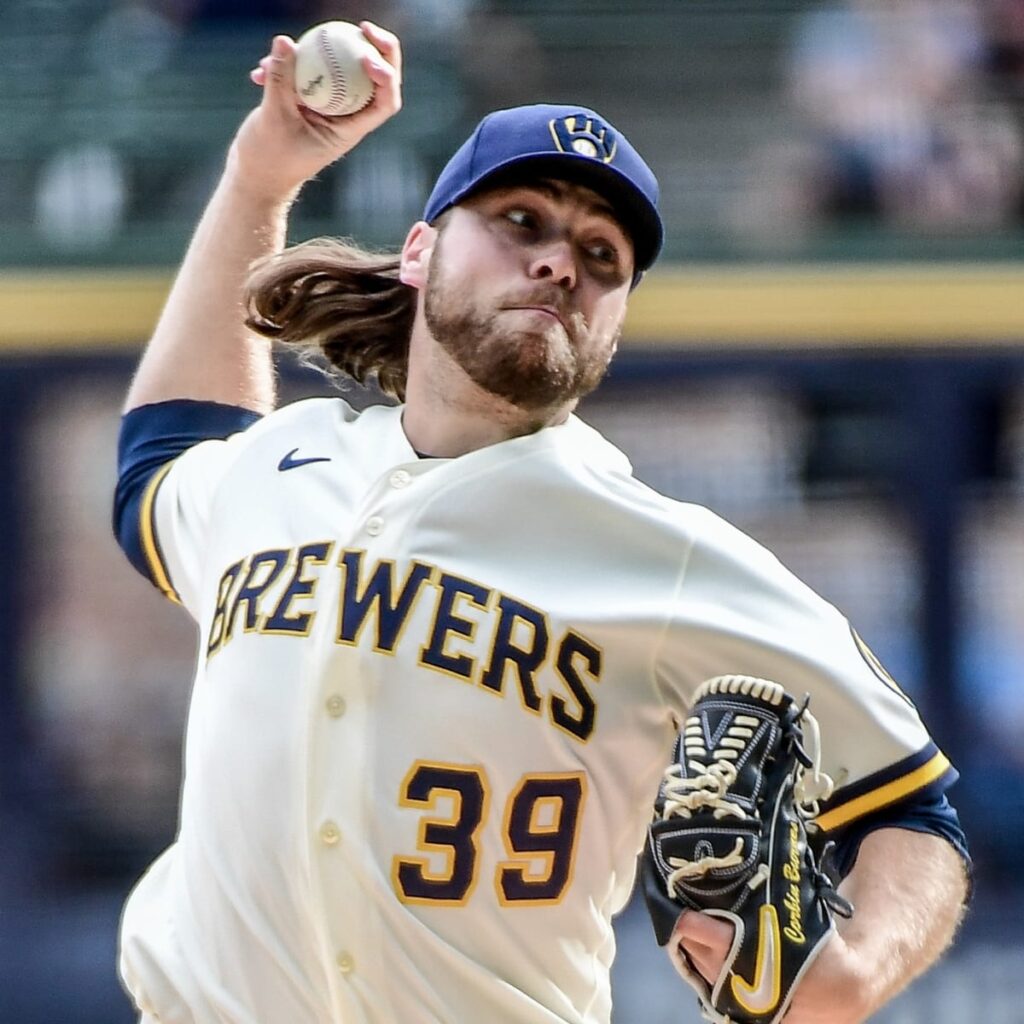
For Milwaukee to compete for their division table, they need their top two arms (Corbin Burnes and Brandon Woodruff) to dominate at the front of their rotation, plus receive a productive season out of SP Freddy Peralta. I’m not a fan of Wade Miley as a fifth starter, but he should at least eat up some innings. 

Devin Williams looks poised to stand tall in the closing role with a higher ceiling with a few more strikes thrown. The supporting cast in the bullpen will need some massaging to compete with the better teams in the league. 

Offensively, the demise in power by OF Christian Yelich takes him out of the elite bat conversation. The Brewers offer some power, but they lack the foundation of star players. They hope OF Garrett Mitchell and 2B Brice Turang develop into competitive pieces for their team in 2023.

Starting Lineup


OF Jesse Winker

Winker flashed improved power in 2020 and 2021 (39 doubles, one triple, and 36 home runs over 572 at-bats). He even offered a plus approach over this span (walk rate – 12.1 and strikeout rate – 18.1). However, his biggest obstacle remains his ability to stay healthy. Winker missed the final six weeks in 2021 with a rib issue that was tied to a lower back injury a couple of days prior.

Last season, Winker failed to build on his growth, leading to a disappointing first half (.235/26/6/32 over 268 at-bats) while staying relatively healthy (slight right shoulder issue in late May). He started July with a six-game suspension, followed by ankle, back, and wrist injuries after the All-Star break. His lack of success at the plate led to fewer at-bats over the final three months (.197 over 188 at-bats with 25 runs, eight home runs, and 21 RBIs).

Winker played better vs. left-handed pitching (.244/14/6/20 over 119 at-bats) while maintaining a favorable approach (strikeout rate – 18.8 and walk rate – 15.4). His contact batting average (.283) came in well below his previous two seasons (.369 and .371), with regression in his average hit rate (1.570).

His change in his launch angle (16.8 – 10.8 in 2021) led to a career-high in his flyball rate (40.6 – 33.1 in his career). Unfortunately, Winker had a sharp decline in his HR/FB rate (9.7 – 20.7 in 2021 and 17.1 in his career), highlighted by a spike in his infield flyballs (17.4% – never higher than 9.5% before last season). In essence, he appeared to want to hit more home runs, but Winker lost his timing, leading to weaker contact (exit velocity – 87.7 – 90.6 in 2021 ~ hard-hit rate – 34.3 – 47.1 in 2021). 

Fantasy Outlook: His ADP (267) in the NFBC is 159 spots higher in 2021 (108). His ability to take walks, paired with an expected rebound in contact batting average, points to Winker hitting at the top Brewers’ lineup. He has yet to have more than 460 at-bats in the majors. At the very least, Winker is an.280/80/20/80 hitter with 500 at-bats, making him a value in 2023.

2B Luis Urias

Urias turned into a beast at AAA in 2019 (.315 with 62 runs, 19 home runs, 50 RBIs, and seven steals over 295 at-bats), but he’s failed to have any success in the majors over parts of his first three seasons (.226 with 43 runs, six home runs, and 40 RBI over 372 at-bats). 

The Brewers gave him the best opportunity of his career in 2021, leading to career-highs in at-bats (490), runs (77), home runs (23), and RBIs (75). Last year, he started the season on the injured list with a quad issue. Over the first two months, his bat underperformed in batting average (.217), but Urias delivered competitive stats in runs (25), home runs (8), and RBIs (24) over 180 at-bats. He finished the season with no edge over his final 226 at-bats (.257/29/8/23).

His approach (strikeout rate – 21.0 and walk rate – 10.6) has been favorable over the past two seasons. Urias has a fading average hit rate (.316), with a slight step back in his average hit rate (1.691) in 2022. In addition, he hit set a new top in his flyball rate (43.3) while delivering a weaker HR/FB rate (11.9 – 16.1 in 2021). Urias ranked poorly in exit velocity (87.3 – 228th) and hard-hit rate (35.3 – 229th).

Over seven seasons in the minors, he hit .306 with 367 runs, 36 home runs, 221 RBIs, and 42 stolen bases over 2,078 at-bats.

Fantasy Outlook: Milwaukee should have him in the starting lineup on most days in 2023. He has the approach to hit in the top two spots in the starting lineup. I don’t consider him a 30-home-run hitter, but I can’t dismiss his average hit rate (1.903) in 2019 at AAA. His ADP (241) looks to be a buying opportunity. Urias looks ready to raise his ceiling. With 500 at-bats, a .270/75/20/75/5 looks well within reach. 

OF Christian Yelich

Since his last impact season in 2019 (.329/100/44/97/30 over 489 at-bats), Yelich hit .243 over 1,174 at-bats with 208 runs, 35 home runs, 130 RBIs, and 32 stolen bases. His average hit rate (1.517), contact batting average (.351), and RBI rate (13) makes him a shell of his once self. In addition, Yelich finished with a strikeout rate (24.1) over his career average (21.8) for the third consecutive season. He still has strength in his walk rate (13.8).

Despite his perceived weaker output, he finished 46th in FPGscore (2.35), thanks to his value in runs (1.71) and steals (1.92). Yelich only hit .207 over 213 at-bats with 32 runs, four home runs, 22 RBIs, and six steals when batting fourth in 2022. He battled a minor back issue in July and September. 

His swing path continues to deliver a tremendous number of ground balls (58.6% – 55.8 in his career) and a weaker HR/FB rate (14.7 – over 32.0% from 2019 to 2020). However, Yelich did maintain a high exit velocity (91.5 – 32nd) and hard-hit rate (48.6 – 26th), and worm-killing launch angle (3.6 – 307th ~ 5.0, 11.3, and 7.1 from 2018 to 2020).

Fantasy Outlook: Yelich is a workable fantasy piece to the puzzle, with a chance to be much better with a few more balls traveling higher out of the infield. The change in shift rules should offer a natural correction in his batting average by 10% of his 242 groundballs in 2022 turning into hits. His ADP (129) in the National Fantasy Baseball Championship ranks him as the 77th hitter drafted. With a healthy season, I expect Yelich to outperform his price point. The bet is on .290 with 100 runs, 18 home runs, 75 RBIs, and 20 steals.

SS Willy Adames

Adames duffed his way through his first quarter of 2021 with Tampa Bay, leading to a .197 batting average over 132 at-bats with 16 runs, five home runs, and 15 RBIs while whiffing 35.9% of the time. After a trade to the Brewers, his game reached a new ceiling. He hit .285 with 61 runs, 20 home runs, 58 RBIs, and four stolen bases over 365 at-bats. His walk rate (11.4) and strikeout rate (25.4) with Milwaukee were the best of his career.

In 2022, Adames set career highs in at-bats (563), runs (83), home runs (31), and RBIs (98), with a push higher in his average hit rate (1.925). His strikeout rate (26.9 – 28.2 in his career) improved slightly while remaining a liability. He finished with his lowest contact batting average (.338) in five seasons. 

A left ankle sprain in mid-May led to three weeks on the injured list. Adames played his best ball over the final three months (.254 with 46 runs, 16 home runs, 57 RBIs, and seven stolen bases over 346 at-bats).

He added loft again to his swing path (fly-ball rate – 45.9 and 37.3 in his career). However, Adames had a slight regression in his HR/FB rate (16.8). His exit velocity (88.9 – 147th) didn’t match up with his hard-hit rate (43.6 – 86th) while having a bump in his launch angle (18.9 – 35th).

Fantasy Outlook: His growth in power and improved RBI rate (17) point to Adames earning a middle-of-the-order opportunity this year. His ADP (98) in the high-stakes market ranks him as the 57th hitter off the board, a few notches below his FPGscore (3.32 – 33rd) ranking in 2021. He’s getting better, but I don’t see a difference-maker player. I view him close to being a neutral four-category player with some batting average risk.

1B Rowdy Tellez

From 2019 to 2021, Tellez hit .241 with 103 runs, 40 home runs, and 113 RBIs over 780 at-bats. He did a much better job controlling the strike zone over the past three years in the majors (strikeout rate – 20.1 and walk rate – 9.2), pointing to an improved opportunity with the Brewers.

Milwaukee gave Tellez the best opportunity over his career last season, allowing him to set career highs in at-bats (529), runs (67), hits (116), home runs (35), and RBIs (89). His bat had minimal value against lefties (.209 with 11 runs, four home runs, and 11 RBIs over 115 at-bats) while playing better at home (.231/34/22/52 over 255 at-bats). Tellez finished the season with a .196 batting average over his final 275 at-bats with 38 runs, 20 home runs, and 41 RBIs. 

Tellez has had a high HR/FB rate (22.2, 21.6, and 25.0) in his first three seasons with Toronto, but he lost his power stroke in 2021 (HR/FB rate – 12.4). Last year, his swing path led to a much higher flyball rate (45.5 – 38.2 in 2021 and 33.7 in 2020), with a rebound in his HR/FB rate (18.7). His exit velocity (91.1 – 42nd) and hard-hit rank (46.0 – 54th) ranked favorably.

Fantasy Outlook: Tellez must regain some of his lost contact batting average (.284) to become a more valuable fantasy player. His ADP (162) in the NFBC ranks him 16th at first base. His approach and power paint a higher overall ceiling, but Tellez does need to play better vs. left-handed pitching. His 30-home run power is real, and the Brewers will give him plenty of at-bats in the heart of their batting order. Think Prince Fielder without the pedigree.

3B Brian Anderson

Miami placed Anderson on the injured list twice with a left shoulder issue in 2021, leading to surgery in September. He also missed time earlier in the year with an oblique issue. Last season, a back issue led to Anderson landing on the injured list for a month in May. He missed another 19 days over the summer with a left shoulder injury.

At no point in 2022 did Anderson play well. His walk rate (9.2) remains an asset, but he continues to have a fading strikeout rate (26.4 – 23.3 in 2021). His swing path continues to lead to many ground balls (50.4%). However, his shoulder woes led to more regression in his HR/FB rate (10.8). 

Fantasy Outlook: Anderson hit .233 over his last 571 at-bats with 67 runs, 15 home runs, 56 RBIs, and six steals over the past two seasons while not being healthy. In 2019 and 2020, his appeared to be trending upward in power (.260/84/31/104/5 over 659 at-bats). He’ll be found in the free-agent pool in most redraft formats until Anderson proves his worth on the field.

OF Garrett Mitchell

The future center fielder for the Brewers is Mitchell. His speed is electric while offering a difference-maker glove and exceptional arm. In 2019 in college, he hit .349 with 57 runs, six home runs, 41 RBIs, and 18 stolen bases over 258 at-bats. Milwaukee snatched him with the 20th selection in the 2020 MLB June Amateur Draft.

His bat played well over his first 92 at-bats at High A, leading to a .359 batting average with 33 runs, five home runs, 20 RBIs, and 12 stolen bases. However, after a promotion to AA in 2021, Mitchell looked overmatched at the plate (.186 with 16 runs, three home runs, 10 RBIs, and five steals over 129 at-bats) while striking out 27.7% of the time.

Milwaukee gave Mitchell 239 at-bats last season at AA and AAA, leading to a .297 batting average with 44 runs, five home runs, 34 RBIs, and 16 steals. His contact batting average (.407) rose for the second straight season, with strength in his walk rate (10.4) but some risk in his strikeout rate (25.6). With the Brewers, he helped fantasy teams over the final 15 games (15-for-35 with five runs, one home run, three RBIs, and five stolen bases). On the downside, Mitchell struck out 41.8% of the time in Milwaukee. However, his exit velocity (92.9) ranks well in the majors.

Fantasy Outlook: Mitchell looks the part of a much better player, but he needs to cut down on his strikeouts and add more loft to swing to reach his potential in power. He checks the plus speed box, but Mitchell can’t move up the batting order until his approach improves. I expect him to be the Brewers starting centerfielder in 2023. His ADP (308) in the NFBC seems too good to be true if the Brewers give him 500 at-bats. Mitchell could stumble through the season and hit double-digit home runs with 30+ steals. His glaring strike is only 73 at-bats of experience at AAA and 187 at-bats at AA.

C William Contreras

Over seven seasons in the minors, Contreras hit .281 with 193 runs, 31 home runs, 190 RBIs, and four steals. His bat played well at AAA (.291/28/9/37 over 203 at-bats). In addition, he posted a league average walk rate (8.2), with a favorable strikeouts rate (18.5).

Contreras gave the Braves a ton of power over the past two seasons (.258 with 70 runs, 28 home runs, 68 RBIs, and two steals over 497 at-bats). His contact batting average (.404) was the highest of his career last year with Atlanta. He still needs more work on his strikeout rate (27.7) while improving his walk rate (10.4).

His exit velocity (90.4 – 63rd) and hard-hit rate (46.6 – 45th) graded well. But surprisingly, his launch angle (6.1 – 284th) didn’t match up with his home run output (20). His groundball rate (53.0) was higher than his recent seasons in the minors.

Fantasy Outlook: The underlying metrics for Contreras suggest he has plenty of room for growth, starting with his approach and swing path. His ADP (121) in the NFBC requires him to receive 450+ at-bats with 60 runs, 20 home runs, and 60 RBIs. The Brewers want him in the lineup as much as possible, and Contreras had his best edge against lefties (.354 with 15 runs, five home runs, and 15 RBIs over 99 at-bats). I’m interested, but I don’t think he’ll fit my plan inside the first 150 selections.

OF Tyrone Taylor

The Brewers gave Taylor 616 at-bats over the past two seasons, leading to 82 runs, 29 home runs, 94 RBIs, and nine steals. His strikeout rate (25.2) increased each year in the majors. He continues to have a low walk rate (5.4). 

Over his 10 years in the minors, Taylor hit .272 with 409 runs, 70 home runs, 375 RBIs, and 90 stolen bases over 2,935 at-bats. His best success came in 2018 at AA (.278 with 73 runs, 20 home runs, 80 RBIs, and 13 steals over 446 at-bats). He had a slightly higher walk rate (6.8) and a much lower strikeout rate (13.6). 

He didn’t have an edge against right-handed (.237/32/12/37 over 253 at-bats) or left-handed (.225/17/5/14 over 120 at-bats) batters. Taylor had his best value in May (.279/12/6/21/1 over 86 at-bats). The Brewers gave him fewer than 70 at-bats in July (28), August (62), and September (69).

Fantasy Outlook: There are flaws in Taylor’s bat while also having some underlying hints of upside. I don’t expect 500 at-bats, making Taylor challenging to time. His ADP (395) points to a borderline bench role in deep formats. Taylor makes more sense as a ride him while he is a “hot” player.

1B Keston Hiura

Hiura hit .307 with 180 runs, 50 home runs, 164 RBI, and 26 stolen bases over 1,084 at-bats while having a much more attractive strikeout rate (23.4) over five seasons in the minors. In 2019, between AAA and the majors, he hit .313 with 95 runs, 38 home runs, 85 RBIs, and 16 stolen bases over 527 at-bats.

After flashing with Milwaukee in his rookie season (.303/51/19/49/9 over 314 at-bats), he only hit .205 over his last 624 at-bats with 80 runs, 31 home runs, 83 RBIs, and 11 stolen bases). His strikeout rate (38.5) has been a massive problem over this span while regressing each year (34.6, 39.1, and 41.7). 

When on his game, Hiura delivers an exceptional contact batting average (.418 in the minors and .399 with Milwaukee) and strength in his average hit rate (2.008 at AAA and 1.906 in the majors). He had insane struggles against left-handed pitching (.188 over 96 at-bats with 11 runs, three home runs, 11 RBIs, and 49 strikeouts). 

Fantasy Outlook: At age 26, many fantasy managers will cross Hiura off their cheat sheet due to his inability to make contact and his batting average risk. His ADP (513) leaves him snookered in the free-agent pool in most redraft formats. He is a worthy dart if Hiura shows a spark early or in spring training, as his downside is a kick to the free-agent curb after being sent back to AAA, with his only damage coming from some underperforming at-bats.

SS Brice Turang

After starting his minor league career with a light-hitting power profile (.261 with 178 runs, 10 home runs, 108 RBIs, and 64 RBIs over 1,063 at-bats), Turang developed into a more all-around player in last season at AAA (.286/89/13/78/34 over 532 at-bats). His walk rate (12.9) has top-of-the-order upside with a favorable strikeout rate (18.1).

Turang finished with a career-high in his contact batting average (.367) with only small gains in his average hit rate (1.441). His best asset early in his career looks to be his value in stolen bases (98-for-116). 

Fantasy Outlook: The Brewers should have him on their major league roster early in 2023, with his best path for starts possibly coming at second base with Brian Anderson shifting to the outfield and Luis Urias seeing some time at third base. His ADP (410) in the high-stakes market is a reasonable flier for a fantasy drafter looking for steals in deep formats. Turang is getting better, so keep an open mind if he plays well in spring training.

Starting Pitching


SP Corbin Burnes

Burnes has been electric over his last 73 games (27-14 with a 2.62 ERA, 0.964 WHIP, and 565 strikeouts over 428.2 innings). He led the National League in starts (33) and strikeouts (243) in 2022 after a top ranking in ERA (2.43) and strikeout rate (12.6) the previous season. His walk rate (2.3), strikeout rate (10.3), and first-pitch strikeout rate (58) regressed last year. 

Over his 33 starts, Burnes allowed two runs or fewer in 18 games in which he pitched at least five innings. He had a 2.39 ERA, .182 BAA, and 181 strikeouts over his first 143 innings. His arm lost value over his next eight starts (5.25 ERA, 1.25 WHIP, seven home runs, and 50 strikeouts over 48 innings). Burnes tossed 11 shutout innings with no walks and 12 strikeouts to end the season.

His average fastball (96.2) had a setback in velocity (96.8 mph in 2021). Burnes threw a cutter as his top volume pitch (.212 BAA). Batters struggled to hit his curveball (.127 BAA), changeup (.219 BAA), and slider (.165 BAA). He saw his HR/FB rate (14.1) more than double his results in 2021 (6.1). 

Fantasy Outlook: Burnes ranked sixth in FPGscore (6.37) for pitchers. His ADP (11) in the NFBC prices him as the second starting pitcher drafted in 2023 behind Shohei Ohtani. Milwaukee worked him hard last season, leading to him throwing 100 or more pitches in 16 of his 19 final starts. Last season, Burnes showed more risk in the fifth and sixth innings (4.93 ERA and 11 home runs over 54.2 innings with 61 strikeouts). He looks to be the best-looking arm on the block, but some signs suggest 2023 won’t go as smoothly.

SP Brandon Woodruff

A right ankle injury put Woodruff on the injured list in late May for a month while also battling some numbness in his fingers on his pitching hand. He struggled over his first nine starts (4.74 ERA) due to three poor showings (16 runs, 28 baserunners, and 14 strikeouts over 12 innings). After returning from his injury, Woodruff went 8-1 over his final 18 starts with a 2.38 ERA, .202 BAA, and 137 strikeouts over 109.2 innings.

He had his best value at home (8-0 with a 2.06 ERA and 107 strikeouts over 78.2 innings). Woodruff pitched more up in the strike zone (flyball rate – 43.4 – 35.3% in his career). His ERA (2.84) has been an edge over his last 406.1 innings with 492 strikeouts. 

His average fastball (96.4) remains elite. Batters failed to gain an edge against four of his pitches (four-seamer – .185 BAA, changeup – .207, curveball – .231 BAA, and slider – .200 BAA). Woodruff pitched into the seventh inning in five starts of his 27 starts.

Fantasy Outlook: He checks the command box with the arsenal to push his workload higher. His ADP (34) in the NFBC puts him in the top-tier conversation with the best arms in the game. Woodruff now needs to pitch over 180 innings and make 32 starts to push his stats to a higher level. On a path to another 3.00 ERA and 215 strikeouts with 190 innings.

SP Freddy Peralta

Peralta had a breakthrough season in 2021, but he finished with minimal growth in his walk rate (3.5) while almost repeating his strikeout rate (12.2). Batters only hit .165 against him (.257 in 2019 and .204 in 2020).

In 2022, he tripped up in two (11 runs and 13 baserunners over six innings) of his first eight games, leading to a slow start in ERA (4.42). A lat/shoulder issue led to Peralta landing on the injured list for 10 weeks. He drove the bus home with a 2.75 ERA, .153 BAA, and 36 strikeouts over 39.1 innings. Shoulder fatigue in September led to him pitching short innings over his final four appearances.

His average fastball (92.9) was down about a half mph. Peralta had electric success with all four of his pitches (four-seamer – .220 BAA), slider (.207 BAA), curveball (.154 BAA), and changeup (.133 BAA). 

Fantasy Outlook: Peralta is a dilemma arm for me in 2023. He is extremely challenging to hit with improving command, but his shoulder issue remains a factor in his playable value. This season, he projects as an SP3 with an ADP (141) in the high-stakes market. However, I can’t expect more than 150 innings with a 3.25 ERA and 175 strikeouts.

SP Eric Lauer

In 2020, Lauer suffered a left shoulder injury in March. With four months to recover, he looked ready for the late start of the season in July. However, a battle with Covid-19 led to a couple of days on the injured list. Lauer was a disaster over his four appearances (16 runs and 26 baserunners over 11 innings).

Over his first three seasons in the majors, he went 14-17 with a 4.75 ERA and 250 strikeouts over 272.2 innings. Surprisingly, Lauer helped fantasy teams in 2021 over 118.2 innings (3.19 ERA and 117 strikeouts). His walk rate (3.1) improved slightly, with help in strikeouts (8.9 per nine).

Lauer pitched surprisingly well over his first five starts (3-0 with a 1.82 ERA, 0.944 WHIP, .189 BAA, and 42 strikeouts over 29.2 innings) in 2022. He gave back much of his gains over his next nine starts (5.36 ERA, 1.397 WHIP, and 38 strikeouts over 48.2 innings) due to battles with home runs (12). Lauer regained his form over his final 15 starts (3.36 ERA and 77 strikeouts over 80.1 innings). 

His average fastball (93.3) was a career-high. Lauer has success with his four-seamer (.180 BAA) and slider (.169 BAA), but he struggled to find the rhythm with his curveball (.329 BAA), cutter (.292 BAA), and changeup (.357 BAA).

Despite his success, Lauer allowed too many home runs (1.5 per nine) with some regression in his walk rate (3.3). Much of his work is needed against right-handed batters (48 walks and 24 home runs over 495 at-bats). 

Fantasy Outlook: His season ended with a left elbow injury. Lauer averaged only 5.5 innings per start. He comes off the board as the 106th pitcher in the NFBC with an ADP of 279. I expect his ERA to drive his draft value, but I don’t trust him to repeat while having some injury risk.

SP Aaron Ashby

Over his first three seasons in the minors, Ashby went 12-17 with a 3.75 ERA and 301 strikeouts. However, his walk rate (4.0) regressed as he moved up through the minors. 

Despite struggling at AAA in 2021 (5-4 with 4.41 ERA and 100 strikeouts over 63.1 innings), the Brewers called him up for a spot start (four runs and seven base runners over two-thirds of an inning) in late June. Later in the year, Ashby flashed out of their bullpen over 11 games (1.78 ERA, .168 BAA, six walks, and 38 strikeouts over 30.1 innings). Unfortunately, his season ended with a disastrous outing (six runs, six baserunners, and one home run over two-thirds of an inning).

The Brewers used Ashby in a split role over his first 11 games in 2022, leading to a 2.70 ERA, .207 BAA, and 51 strikeouts over 40.0 innings while battling his command (22 walks). After three poor showings (14 runs, 27 baserunners, and three home runs over 15 innings), he landed on the injured list for a couple of weeks with a forearm issue. His arm lost value over his next nine games (5.01 ERA, 1.403 WHIP, and eight home runs over 41.1 innings). Ashby also battled a left shoulder injury late in August, pretty much ending his fantasy season.

His average fastball (95.9) was down over one mph. Ashby threw a plus slider (.176 BAA) and a winning curveball (.235 BAA), but he lost the feel for his changeup (.270 BAA) and sinker (.289 BAA). 

Fantasy Outlook: In early February, the Brewers shut him down with shoulder fatigue, putting his start of the season on hold. I expect his ADP (232) in the high-stakes market to fall due to his injury. Ashby is an easy avoid this year. He looks closer to TJ surgery than helping a fantasy team in 2023, and his shoulder isn’t healthy.

SP Wade Miley


Miley helped Milwaukee and Houston in 2018 and 2019 (19-8 with a 3.52 ERA and 190 strikeouts over 248 innings), but his walk rate (3.2) and strikeout rate (6.9) don’t project upside.

In 2020, Miley missed time with a groin injury while also batting with a left shoulder issue. His two stints on the injured list led to six poor showings (5.65 ERA and 1.674 WHIP). He helped fantasy teams in 2021 by going 12-7 with a 3.37 ERA and 125 strikeouts over 163 innings. However, he struggled with right-handed batters (.276 with 14 home runs and 43 walks over 503 at-bats).

His season was cut short in 2022 due to elbow, shoulder, and oblique injuries. Miley allowed three runs or less in all nine appearances, but he pitched more than five innings in only two games. He issued 3.4 walks per nine with continued weakness in his strikeout rate (6.8)

His average fastball (89.2) was a career-low with four consecutive years of regression. Miley had the worst outcomes with his changeup (.255 BAA), but his sample size was small for all his pitches. 

Fantasy Outlook: Over the previous five seasons, he went 33-20 with a 3.50 ERA and 355 strikeouts over 462.1 innings. At age 36, Miley is extremely challenging to trust over a long season. His ADP (536) puts him in the free-agent pool in all redraft leagues.

SP Ethan Small

The Brewers drafted Small with the 28th selection in the 2019 MLB June Amateur Draft. Over his final two seasons in college, he went 15-6 with a 2.55 ERA and 298 strikeouts over 208.1 innings.

Small pitched well over his first 25 starts in the minors, leading to a 1.74 ERA and 128 strikeouts over 98.1 innings. However, his walk rate (4.9) regressed in 2021. He posted a 2.06 ERA over 35 innings at AAA despite issuing 21 walks with 24 strikeouts. Small missed some time in July and August with a finger injury.

Last season, Small lost his way at AAA (4.46 ERA, 1.359 WHIP, and 114 strikeouts over 103 innings) due to further regression in his walk rate (5.1). Batters only hit .223 against him. Heading into his final start in August, he had a 3.78 ERA and 106 strikeouts over 95.1 innings, but Small struggled in his next two outings (14 runs, 24 baserunners, and two home runs over 8.1 innings). The Brewers pitched him in relief for the remainder of the season at AAA. 

In his two starts in the majors, he allowed five runs, eight hits, eight walks, and one home run over 6.1 innings with seven strikeouts. His average fastball (91.2) was well below the league average. Small relies on a plus changeup and a low-volume slider. 

Fantasy Outlook: Small isn’t that far away from the majors, but he needs to solve AAA first. His signal of growth will be improved command. Milwaukee may decide to use him out of the bullpen this season.

Bullpen


CL Devin Williams

Williams started his career as a starter in the Brewers’ system after getting drafted in the second round in 2013. After missing 2017 with a right elbow injury that required TJ surgery, he struggled in 2018 as a starter over 14 games at High A (0-3 with a 5.82 ERA and 35 strikeouts over 34 innings). As a result, Milwaukee shifted him to the bullpen in 2019, leading to success at AA (7-2 with a 2.36 ERA and 76 strikeouts over 53.1 innings with four saves). 

In 2020, his arm exploded on the major league scene after allowing one run and eight hits over 27 innings with 53 strikeouts. Williams had an impressive strikeout rate (17.7) while walking three batters per nine innings. Eight of his nine walks came against left-handed batters over 62 at-bats.

Williams pitched well over the past two seasons (14-6 with a 2.20 ERA, 1.090 WHIP, 183 strikeouts, and 19 saves over 114.2 innings) despite battling his command (4.6 walks per nine). From May 13th to July 30th in 2022, he pitched 28.2 shutout innings with 11 hits, eight walks, and 47 strikeouts, prompting Milwaukee to trade Josh Hader to the Padres. As the full-time closer over the final two months, Williams converted nine of his 11 save tries with a 2.57 ERA and 30 strikeouts while walking 11 batters.  

His average fastball (94.1) was more than 2.50 mph below his peak in 2020 (96.7). Williams almost has an unhittable changeup (.183 BAA – .151 in his career). Batters struggled to hit his four-seam fastball (.090 BAA – with only one extra-base hit over 78 at-bats). He still doesn’t have a third pitch of value (show-me slider – .333 BAA). 

Fantasy Outlook: Williams keeps the ball on the ground (51.4% – 48.8 in his career). His ADP (49) in the NFBC ranks him as the fifth closer off the board in 2023. The Brewers had 52 saves last year, putting Williams on a path to compete for a league-high in saves with help in ERA and WHIP. With more strikes thrown, his arm would be that much better.

RP Matt Bush

The Padres drafted Bush first overall in the 2004 MLB June Amateur Draft as a shortstop. His bat failed to make an impact at A ball in 2005 (.221/56/2/32/8 over 453 at-bats), starting his transition to the mound. Over seven seasons in the minors as a reliever, he went 8-6 with a 3.38 ERA, 155 strikeouts, and 11 saves over 109.1 innings.

Bush pitched well out of the Rangers’ bullpen in 2016 (7-2 with a 2.48 ERA and 61 strikeouts over 61.2 innings), earning him a shot at saves (10 with a 3.78 ERA) in 2017. Unfortunately, injuries and an off-the-field issue led to barely pitching from 2018 to 2021. 

Last year, Bush threw the ball well (3.47 ERA and 74 strikeouts over 59.2 innings) between Texas and Milwaukee. Despite some success, home runs (11) were a significant problem. 

His average fastball (97.4) still has elite velocity. Batters struggled to make hard contact against his four-seamer (.189 BAA) or curveball (.161 BAA). He threw an ineffective slider (.300 BAA).

Fantasy Outlook: Bush has a minimal chance of ever earning another closing role. His battle with home runs leads to some disastrous innings. The Brewers will pitch him in a setup role in 2023. His ADP (575) puts him in the free-agent pool in all formats.

RP Peter Strzelecki

Over four seasons in the minors, Strzelecki went 8-5 with a 3.56 ERA, 228 strikeouts, and 10 saves over 172 innings. His arm made a step forward at AAA last season (4-0 with a 2.84 ERA, 50 strikeouts, and three saves over 31.2 innings), earning his first chance in the majors.

He repeated his success in ERA (2.83) with help in strikeouts (40 over 35 innings) while issuing a few more walks (3.9 per nine – 2.8 in the minors).

His average fastball (93.5) was about league average. Strzelecki had success with his four-seamer (.206 BAA), slider (.244 BAA), and changeup (.167 BAA).

Fantasy Outlook: His closing experience gives Strzelecki a chance to work as Williams’s handcuff in 2023. He has a short resume of success, and his fastball doesn’t separate him from the best arms in the game. 


To read all the MLB Team Outlooks detailed and analyzed by a high-stakes fantasy baseball legend, become a member today!

You can either buy all the Outlooks as a downloadable for a one-time discounted price of $30 or Join the FullTime fam with a Monthly6-Month, or Annual Membership which includes everything we do for ALL SPORTS!

This week only, use PROMOSHAWN23, for an additional 15% off any package!



GET THE UPDATES!

Turn on your email notifications for Breaking Fantasy news alerts & site updates.